In his book “Ways of Seeing”, John Berger asserts that women’s self has been split in two, that a woman is “…almost continually accompanied by her own image of herself.” Today this concept can be seen as short-sighted. He later states that “Glamour cannot exist without personal social envy being a common and widespread emotion.” The majority of people in post-modern society not only watch themselves at all times, they visualize versions of their potential selves and are envious of them.
In Adam Curtis’ “The Century of the Self” (http://en.wikipedia.org/wiki/The_Century_of_the_Self) , he describes many of the political motivations behind various schools of social thought. The overarching theme is that of powerful men in a post-industrial society doing whatever they can to gain more power, utilizing new psychological techniques as ways to increase revenue and control society. One of the biggest changes in human civilization came in the 1960’s, when the idea first appeared with some authority that with regard to pursuits and happenings of life, “It’s empty and meaningless that it’s empty and meaningless.” Society changed from conformist to non-conformist. This overthrew all the preconceptions held by the world’s capitalist structure, which was built on a society of limited potential needs which, when met, would mean the end of a seller’s ability to offer them their products. As Daniel Yankelovich states in the Part III, “Products have always had an emotional meaning. What was new was individuality, the idea that ‘This product expresses me’… in 1970, [the self actualizing individual] was a small percent of the population, maybe 3-5%. By the 1980’s it was a majority of the population, maybe 80%.” John Berger’s book, “Ways of Seeing” was first published in 1972, before capitalist interests had fully established post-modern techniques. Beforehand, it was feared that supply would outstrip demand. As Yankelovich says, we went from a conception of “…a market of limited needs, and if you filled them they’re filled, to a market of unlimited, ever-changing needs dominated by self-expressiveness: that products and services in an endless variety of ways, and ways that change all the time. And consequently, economies have unlimited horizons.”
Necessary to this new economy is the concept of glamour, and intrinsic to glamour is the state of being continually accompanied by one’s own image of oneself. For centuries it was almost exclusively women that were subject to this form of manipulation; a society ruled by men had long-established cultural standards which reinforced the need for women to ‘survey themselves continually’ and maintain themselves as objects of value to the men under whose keeping they had been born and led. Post-modern society has taken advantage of this idea and inflicted it on all people regardless of gender in order to increase the power of those who hold it, through revenue and political manipulation.
Ronald Reagan’s campaign of taking government off the backs of the people, appealing to the self-actualizers and nonconformists led them to believe that by giving him the most powerful position in the world, it gave them power over their own daily lives. This idea is also seen in advertising, which continually proposes a liberated self to the viewer, capitalizing on this newly popular school of thought that one’s individual happiness is what is most essential in life rather than the old protestant view exemplified by buying life insurance, a monthly personal sacrifice made in order to ensure one’s ability to support their family even in death. The new cornerstone to individual happiness was self expression through selective purchasing according to one’s lifestyle. This idea was reinforced by the many entrepreneurs seeking ways to get their products into people’s homes. Their assertion was that by purchasing their product, one was displaying to the world whatever it was that made them special. In order to sustain this form of economy people must be unhappy with their current self, and continually strive to be more.
The supposed American dream of a stable living, comfortable with your spouse, a couple kids and a dog in a home out in the suburbs, had been uprooted by a constant need for improvement, a never-ending desire for a better way of life. There was no individual architect for this movement, it was continually prodded and shaped by those marketing their goods in order to create an ideal environment for them to make money and gain power. As this new economy created an unlimited set of desires for the consumer, it theoretically had an unlimited potential for growth. However, early in the new century we have started to reach that limit.
According to Charles Fishman of FastCompany, Walmart has a policy of offering the lowest possible price to the consumer, which has bankrupted many of the companies whose wares it sells, notably Vlasic, whose profits fell as much as 25% after Walmart started selling a gallon jar of their pickles for $3. (http://www.fastcompany.com/magazine/77/walmart.html) Because people have a limited supply of money to spend, these new corporations are trying every conceivable way to get what little they can regardless of the consequences to those supposedly working for and with them. In the mad grab for power that has been increasingly built up by those seeking power themselves, the list of victims becomes higher and higher as the income gap between the super rich and everyone else has multiplied over the last few decades. The last time the income gap reached this level was in 1928, just before what is considered to be the start of the Great Depression. (http://www.cbpp.org/cms/index.cfm?fa=view&id=3220)
As we weather through one of the worst recessions in post-industrial history, it is imperative that we root out the cause of this financial crisis and try to compensate for it by restructuring our civilization once again. As we gain greater insight into the methods by which people are influenced, and in order to benefit the majority of people we must handle the responsible use of these methods. We have already spiraled into an endless fight for an intangible betterment of one’s individual status. Perhaps the most important question of the 21st century is, “What must we do to regain a sustainable way of life?”
Wednesday, November 3, 2010

Monday, May 3, 2010
Letter to myself
Lily,
You made it through the semester. I know it wasn't easy, but look at what you accomplished! You will likely get A's in your classes, one in a frustrating Humanity and one in an often boring Art History. You wrote a beautiful film script and shot 90% of it, and organized a whole crew of people to help out. You shot three different films for other people and got nothing but compliments, and did wonderful color correction on the work you did last semester with Joe.
Congratulations, really, I mean it. Take a moment to appreciate your accomplishments and yourself before you get lost again in the continuing mess that has been the undercurrent of your situation.
--Lily
You made it through the semester. I know it wasn't easy, but look at what you accomplished! You will likely get A's in your classes, one in a frustrating Humanity and one in an often boring Art History. You wrote a beautiful film script and shot 90% of it, and organized a whole crew of people to help out. You shot three different films for other people and got nothing but compliments, and did wonderful color correction on the work you did last semester with Joe.
Congratulations, really, I mean it. Take a moment to appreciate your accomplishments and yourself before you get lost again in the continuing mess that has been the undercurrent of your situation.
--Lily
Art History - Late 19th and Early 20th Centuries

Eduard Manet, Olympia
Manet’s Olympia, a Realist painting currently housed in the Musée D’Orsay in Paris, provoked angry critique in the Salon of 1865. The subtlety of the lines in the reclining nude were considered too light, too general, especially in contrast with the extremely dark background. There was a great debate over this painting, and from it arose the impressionists who defended its subtlety. Compared to what came soon after this painting it seems closer to Venetian classicism, especially in the tradition of the reclining nude, which has a vast history starting with Giorgione and exemplified by his pupil Titian, then followed by many artists such as Rubens and Goya.[i] It seems that Manet wanted to make clear what he was taking from tradition and what he was adding to it.
Olympia is a Realist painting. Realism, “discarded the formulas of Neoclassicism and the theatrical drama of Romanticism to paint familiar scenes and events as they actually looked.”[ii] In Olympia, a modern young Parisian woman stares directly at the spectator as though she were Manet himself watching his audience react to the then revolutionary ideas he was proposing. It is likely that the young woman was a Parisian whore, which is especially made clear by the black cat at her feet, symbol of infidelity. A maid is giving her flowers from an unknown suitor. The comparison of a Parisian whore to the mythological grandiosity of traditional reclining nudes such as Giorgione’s sleeping Venus is controversial in itself – critics “advised pregnant women to avoid the picture, and it was re-hung to thwart vandals”[iii] – yet he adds to it a new way of painting, through outlines and patches of color instead of blended smooth and well-defined shapes. Theophile Gautier of Le Moniteur Universel wrote, “the color of the flesh is dirty, the modeling non-existent. The shadows are indicated by comparatively large smears of blacking.” The artist Jules Claretie wrote, “What's this yellow-bellied odalisque, this vile model picked up goodness knows where and representing Olympia?” Art historian Anne McCaulay writes, "The paint sat there on the surface of the canvas...It wasn't just the fact that she's a nude and she's a lower class nude, but also the fact that she was painted in...what many people read as almost childish or unskilled fashion," [iv]
It was not without its support, however. Emile Zola, famed French writer, wrote,
For you a picture is but an opportunity for analysis. You wanted a nude, and you took Olympia, the first to come along; you wanted bright, luminous patches, and the bouquet provided them; you wanted black patches, and von added a black woman and a black cat. What does all this mean? You hardly know, nor do I. But I know that you succeeded admirably in creating a work of painting, of great painting, and in translating into a special language the verities of light and shade, the realities of persons and things.”[v]
Claude Monet and Pierre Renoir were intrigued by the painting, especially in the way he painted with patches of color rather than refined shading. Manet kept the work with him until his death, at which point Monet organized a fund to purchase it and donated it to the French state.

Cézanne, Mt. St Victoire
Rarely is an artist more obsessed with a single subject than was Cézanne with Mont Sainte-Victoire. Living in the region, he made some 60 paintings of it, each reflecting something of his mood and his desire to express the intangible feelings he felt in its presence through impressionistic style. It represented “an inner god that he externalized in this mountain peak--his striving and exaltation and desire for repose.”[vi] These paintings took place during what is sometimes known as his “constructive” period.[vii]
Cézanne said of his painting style, “…if I start reading too much into things, if I am swept along by a theory today that contradicts yesterday’s, if I think when I am painting, if I interfere, then bang, everything slips away.” He developed many interesting techniques which later influenced many artists, with Pablo Picasso claiming him as “My one and only master . . . Cezanne was like the father of us all”[viii].
His work can be classified as post-impressionist, with him saying he preferred painting "something solid and durable, like the art of the museums"[ix]. He developed a characteristic of shallow space, wherein the viewer cannot tell the distance between one object and the other. Many of his forms were simplified to geometric shapes, mere patches of paint applied boldly with a proto-cubist sensibility. To tie them together he was an advocate of the passage, “the blending of overlapping planes into one another”[x

Seurat – Afternoon on the Island of Grande Jatte
Georges Seurat spent two years working on his most famous work, Afternoon on the Island of Grande Jatte. In painstaking pointillism, or divisionism, he depicts an idyllic scene of Parisians relaxing in a park. It is a composite of numerous sketches and studies, first focusing on the park itself and the landscape, and then the people. Seurat was more interested in the shapes of the individuals than he was their personalities. By reducing them to refined shapes with distinct silhouettes he brings a sense of peace to what would otherwise have been a raucous and dynamic scene of dogs playing, boats sailing, children dancing and people moving about.
On his canvas are three dogs, eight boats and forty-eight people, existing in a perfect harmony. Wendy Beckett writes, “Even if the people in the park are pairs or groups, they still seem alone in their concision of form - alone but not lonely. No figure encroaches on another's space: all coexist in peace.” [xi] Seurat stated his intention to be to
“make modern people in their essential traits move about as they do on [ancient Greek] friezes and place them on canvases organized by harmonies.” [xii]
To Seurat, this painting was an attempt to prove his theory that painted dots of pure color, near each other and mixed in the eye rather than on the canvas, would produce a brighter image. He was informed on this theory by the writings of Michel Eugène Chevreul, with what he called “The Law of Simultaneous Contrast”[xiii]. For inspiration on this theory, he looked to the works of Delacroix, Pisarro and Monet, studying their “divided color”, opposing tints that excite the eye.

Claude Monet – Water Lilies
Monet’s Water Lilies, or Nymphaes, are synonymous with the impressionist movement. It is a vast series of almost 250 paintings, with series being a relatively new concept in which no single painting is more important or telling than the next yet they all work together in harmony. Some are small studies, while others are astonishing in scale, such as his "Reflections of Clouds on the Water-Lily Pond”, which stands six and a half feet tall by nearly forty two feet wide in total and is comprised of three panels.[xiv] These works are significant in their experimentation with concept, composition and color theory.
Monet had achieved some wealth and fame by the time he started these paintings. He constructed a garden in Giverny rife with flowers, especially water lilies, and hired six full time gardeners to keep them in shape[xv]. He even built his own Japanese bridge because he felt it would be beautiful in his paintings. This is an interesting development in art because these are not naturally occurring landscapes, which typically glorify religious figures for their creation. These are constructed environments specifically designed for the purpose of being painted, as though they were models being placed by the artist. He called his series Les Grandes Decorations, with the intention of placing them in a large oval room in which the viewer can be completely immersed in his work. [xvi]
In order to completely immerse the viewer, Monet’s compositions lack much of what is expected in a painting. There is no focal point. The center of the paintings is often negative space, and the visual elements are evenly distributed across the scene. There is rarely a horizon line, leaving the viewer with just an open expanse of water and lilies. Everything is of equal importance, and rendered with equal care. He experimented with round canvases, as rectangular canvases are more constructed, with defined lines around the edges. Circles are considered more infinite, as though to mimic the roundness of the eye. One might guess that his reason for eventually painting behemoth canvases is so there can be a vantage point from which the viewer cannot see the edges of the painting, removing the problem altogether.
By removing the subject, the artwork becomes about the treatment. Impressionism is about light, and how it shines through and reflects on objects leaving just an ‘impression’ on the eye of the scene. To bring a rich tone to a subject means mixing seemingly contrary colors on the painting and letting the eyes do the mixing by themselves. Up close, the water lilies are hard to distinguish among the many splashes of color of which they are composed. However, at a distance, the eye blends the color and is left with an image of great beauty and vibrancy.
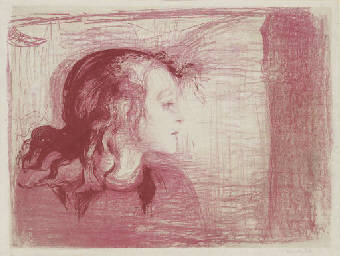

Anxiety, Edvard Munch The Sick Child, Edvard Munch
1896, Lithograph, 42 x 38.7 cm 1896, Lithograph, 42 x 56.5 cm
Edvard Munch’s Prints
When Edvard Munch died, he left to the city of Oslo approximately 1100 paintings, 4500 drawings and 18,000 prints.[xvii] He was prolific as a printmaker, but little is known about where he got his start in the process. He moved to Paris in 1896 and submitted his lithograph of Anxiety, printed by famed lithographer Auguste Clot, to be published by the well-known Ambroise Vollard, which gained him much acclaim. This print is notable in that the two colors, which are normally printed separately, were rolled onto one slab and printed all at once. Munch became known for bold choices in printmaking technique. Paul Herrmann once told a story about his process in making prints of The Sick Child.
The lithographic stones with the large head were already lying side by side in rows ready to be printed. Munch arrived, stood in front of the row, closed his eyes, and waved his fingers in the air without looking, ordering 'Print grey, green, blue, brown'. Then he opened his eyes and said to me, 'Let's go and have a schnapps'. And the printer printed until Munch returned and once more without looking ordered 'Yellow, pink, red' and so it went on a couple more times.”[xviii]
With each major painting came lithographic versions, which made them more available to those who were interested in buying his work. There were prints made of The Scream, Madonna and the rest of his series The Frieze of Life, and many more.

 When he left Paris in 1897 he brought with him a small printing press in order to experiment, and also did more official works through Petersen & Waitz in Oslo (then Kristiania). One of his early experiments was with frottage, which is mostly considered to have come from the later Surrealist movement. It is often practiced today in the form of grave rubbing, in which one takes a crayon and rubs it over a textured surface to get an image wherein the relief is left without color. Sometimes he would take those images and carry them further, drawing on them or layering prints to his liking, such as with his Man’s Head in Woman’s Hair.
 Having his works spread around as much as they were allowed for a broader influence. Gustav Klimt is known to have encountered Munch’s work in the 1909 Vienna Kunstschau, and was strongly affected by it. It is likely that he encountered Munch’s work at an earlier time, however, as Munch’s The Kiss, painted in 1897 and later becoming a woodcut, bears a striking resemblance to Klimt’s The Kiss in the way that the two figures appear to merge together into one monolith.


The Kiss, Edvard Munch The Kiss, Gustav Klimt
1898, Woodcut 1908, Oil and gold leaf on canvas 180 cm × 180 cm

Edvard Munch, The Scream
Munch was known for his expressive, invasive, moody paintings, and there is none more famous than The Scream. It is a seminal work in Expressionist painting, telling of primal fear. It is a part of his Frieze of Life, to which all of his life’s work can be linked. Munch wrote in 1889, “No longer shall interiors be painted with people reading and women knitting. There shall be living people who breathe and feel and suffer and love,”[xix] also stating, “My art is rooted in a single reflection: why am I not as others are? Why was there a curse on my cradle? Why did I come into the world without any choice?” [xx]
It is often cited in medical circles as depictions of various disorders, frequently being alluded to in psychiatric clinics as an illustration of a panic attack, described as, “a sudden episode of intense fear that develops for no apparent reason and that triggers severe physical reactions. Panic attacks can be very frightening. When panic attacks occur, you might think you're losing control, having a heart attack or even dying.”[xxi] In his diary, Munch wrote,
I was walking along a path with two friends — the sun was setting — suddenly the sky turned blood red — I paused, feeling exhausted, and leaned on the fence — there was blood and tongues of fire above the blue-black fjord and the city — my friends walked on, and I stood there trembling with anxiety — and I sensed an infinite scream passing through nature.[xxii]
In this work, the screaming character represents Munch’s feelings and the two walking further on the bridge are his seemingly indifferent friends. His cathartic scream is the focal point, and the subject of the background is distant and primarily used as a means of expressing isolation and intensity. There are two painted versions, two pastels and one lithograph, and in all of them there are the distant friends and the relatively barren color fields in the background, standing on a bridge overlooking Oslo.
According to Robert Rosenblum, Munch had seen a Peruvian mummy in a similar pose at the 1889 Trocadero exposition in Paris, which may have served as some inspiration for the particularly ghoulish appearance of the protagonist.[xxiii] The year prior, in 1892, Munch had painted Death in a Sick-Room, which showed a woman gazing at the viewer with an expressionless mask of an ashy hue. This shows an earlier disposition toward ghastly distortion, which is taken to the utmost level in The Scream. Munch’s Anxiety shows a number of figures crowding the viewer, each with that same sort of expressionless, greenish mask.
Much has been theorized about the color of the sky as described by Munch in his diary, with scientists linking it to the 1883 eruption of Krakatoa,[xxiv] though he is known for his expressive use of color and during episodes of intense panic one is prone to delusions of memory that describe one’s surroundings in terms fitting of the intensity of the feeling.
Today The Scream is instantly recognizable to most people, with reproductions and parodies being commonplace. One can get a The Scream keychain[xxv], with the tagline, “Have your favorite Gothic art figure in your pocket!”, and it has been referenced on television shows such as The Simpsons and cartoons such as Gary Larson’s “Weiner Dog Art”. Even some of the parodies gain a cultish fame: a halloween mask based on The Scream was used in the popular movie franchise Scream. Its success speaks to the insightful expressiveness of the painting itself, touching on a dark place of the human condition to which many can relate, or at least appreciate.
Renoir and Monet, La Grenouillère

Pierre-Auguste Renoir, La Grenouillère, 1869. Oil on canvas. 26 1/8 x 32 7/8 in. (66.5 x 81 cm). NM 2425. National museum, Stockholm.[xxvi]

Claude Monet, La Grenouillère, 1869. Oil on canvas. 29 3/8 x 39 1/4 in. (74.6 x 99.7 cm). H. O. Havermeyer Collection, Bequest of Mrs. H.O. Havermeyer, 1929.[xxvii]
La Grenouillère, “The Froggery”, was a popular restaurant and bathing area in Croissy, France, on the Seine. It was considered a very contemporary subject, and was visited by Emperor Napoleon III and his wife the year Renoir and Monet made these paintings, in 1869.[xxviii] Monet and Renoir often sat beside each other while painting, which is especially evident in these two works.
By comparing the two paintings one can see the many differences and similarities between Monet and Renoir’s early work. Renoir chose to make the focus of the painting the people on the platform, each with much detail and character, focusing on the personality. He fills the canvas with the presence of humankind. His brushstroke is heavy with patches of color on the water and trees, but the people are lovingly defined and posed. The sun seems to be behind the artist, made clear by a few shafts of light striking the platform and the woman’s dress, and the way the background across the river glows warmly. The composition seems crowded, with much more shallow space than Monet’s work.
Monet’s version shows the elegance of the water and the surroundings more than the people. He beautifully renders the water with patches of color, letting nature fill most of the canvas. The water seems more wet and reflective than Renoir’s dry, rough brushstrokes. The focus is still on the people on the platform, but they are very primitive silhouettes compared to Renoir’s details. The entire scene is in shadow except for the opposite side of the Seine, which brings the same warm radiance as in Renoir’s, but is very loosely rendered with none of the careful shading Renoir paints in the trees across the river. Monet has a much deeper field and a more open, airy composition.
All the differences seem to show that Renoir was more of the people, and Monet was more of nature, which continued to be their ways through all their lives.
[i] “The Reclining Nude”, Richard Brafford
[ii] ArtLex on Realism, April 2010
http://www.artlex.com/ArtLex/r/realism.html
[iii] “Manet and his Influence”, 1995 Board of Trustees, National Gallery of Art, Washington. updated 11/2008
[iv] “Culture Shock” The Shock of the Nude: Manet’s Olympia, Prod. Richard P. Rogers, PBS, 2000
[v] “History of Art: The Impressionism”
http://www.all-art.org/impressioniswm_chronicle/01.html
[vi] “Mont Sainte-Victoire”, Nicolas Pioch, WebMuseum, Sep 2002
[vii] Lindsay, Jack. “Cézanne; his life and art” United States: New York Graphic Society.
[viii] "Einstein, Picasso" Arthur I. Miller, New York Times, 2001
[ix] “Paul Cezanne”, The Worldwide Art Gallery, 2010
http://www.theartgallery.com.au/cezanne.html
[x] “Art History Definition: Passage”, Beth Gersh-Nesic
http://arthistory.about.com/od/glossary_p/a/p_passage.htm
[xi] “Sister Wendy's American Masterpieces”, Wendy Beckett, DK ADULT, 2001
[xii] “Seurat and the Making of La Grand Jatte” The Art Institute of Chicago, 2004
http://www.artic.edu/aic/exhibitions/seurat/seurat_themes.html
[xiii] "The Principles of Harmony and Contrast of Colours and Their Applications to the Arts." Encyclopædia Britannica. 2010. Encyclopædia Britannica Online. 02 May. 2010
[xiv] “Claude Monet”, The Museum of Modern Art
http://www.moma.org/collection/object.php?object_id=80220
[xv] “Understanding Monet’s Impressionism” Goldensight, Inc.
http://www.monetartprints.net/monet_art.html
[xvi] “Giverny Grandes Decorations”, Giverny Impression, Ariane Cauderlier
http://giverny-impression.com/grandes-decorations/
[xvii] “The Museum and The Collection”, Munch Museum, 2010
http://www.munch.museum.no/content.aspx?id=2&mid=&lang=en
[xviii] “Edvard Munch as a Graphic Artist” Gerd Woll
[xix]“Munch Museet – Life and work – Biography”, Munch Museet, 2010
http://www.munch.museum.no/content.aspx?id=13&mid=&lang=en
[xx] "Symbolism", Michael Gibson, Taschen, 2006
[xxi] Mayo Clinic Staff, . "Panic Attacks and Panic Disorder." (2010): n. pag. Web. 3 May 2010.
[xxii] “Edvard Munch: The Frieze of Life” Edvard Munch, Arne Eggum, Mara-Helen Wood - 1992
[xxiii] Discovery News, September 7, 2004
[xxiv] "The Blood-Red Sky of the Scream". APS News (American Physical Society), Olson, Donald W.; Russell L. Doescher and Marilynn S. Olson, May 2004
[xxv] “The Munch Scream Keychain from Baron Bob”
http://www.wonderfullywacky.com/scream-keychain.htm
[xxvi] "La Grenouillere, 1869", Shelley Esaak, About.com
http://arthistory.about.com/od/from_exhibitions/ig/renoir_landscapes_07/186583_02.htm
[xxvii] "La Grenouillere, 1869", Shelley Esaak, About.com
http://arthistory.about.com/od/from_exhibitions/ig/frenchmasterpieces/mfp_mma_06.htm
[xxviii] “Webmusem: Monet, Claude: Bathing at La Grenouillère”, Webmuseum, 2002
http://www.ibiblio.org/wm/paint/auth/monet/early/bathing/
Sunday, May 2, 2010
NA meeting
Today I ran an NA meeting. The meeting that was supposed to happen was canceled because the place it was in was closed down, and there were three of us standing at the door, so I suggested we go to a diner. I happened to have the Basic Text, a book that has all the principles and such in it - it was a gift from a week prior, a very nice person gave it to me seeing I was having all sorts of issues. I've read through a good portion of it so I knew where to look for all the text of the meetings, since there are certain traditions, so we decided to have a meeting there. I started us off with the serenity prayer, and then what is the na program, who is an addict, why we are here, how it works and the twelve traditions. We all shared, and one of us with over 20 years sobriety spoke for a long time, so we decided he was the featured speaker if we were trying to have any format, and then we talked for a while and I had the idea of working the first step, the one I've been stuck on for a year.
There was something magical about it. It brought up a lot. I've been having such a hard time accepting being powerless over something so seemingly stupid as an addiction. I've told myself over and over again that I just need to let go and move on. But how do I help myself let go? Traditionally, it's been by getting wasted and damning the torpedoes. I had no idea how powerful a grip on me drugs had until I was sitting infront of a toilet with the goal of flushing them down, just waiting for a random urge and the willpower to follow through, and it never happened. I held the bottle out over the toilet with my fingers covering the opening, and figured, surely, it's easier to just let go than to hold them in like that. But I struggled instead to make sure they all stayed in the bottle. The rationalizations for keeping them were numerous. I decided to try dumping them out my window instead, as I've had an affinity for that lately, tossing paint-filled bottles and such to see the splatter pattern. I live on the 11th floor. Odds are they'd powder on impact. But I knew up there that I'd be dressed in five seconds and at the sidewalk in ten, looking for what was left. A part of me just died, utterly defeated, and I popped four pills and went to the bar and got completely smashed. And honestly, I had a good time there. It would be easier on me if I could say that I didn't, but I did, I played some pool, met some cool people, and was the gregarious nice person I miss being.
I am powerless over my addiction, that's an absolute fact. Now I question whether my life has become unmanageable. Is it because of my addictions? Or is it because I'm a psychiatrist's nightmare? In the past year I've been officially diagnosed with seven disorders.
What all that adds up to is, my life is completely unmanageable without medication. I've been self medicating with drugs, but they have that nasty arc to them that prescriptions are better at avoiding. Mood stabilizers don't make you high or low, they make you okay. Some of the drugs I've been on, like trazodone, made me a complete zombie and I hated it - it was like I felt nothing and had serious anhedonia. Drugs remove my inhibitions, which if set up right means I dance my ass off, or I meet a bunch of cool people, or play some great games. And then there's the hangover/crash at the end if I'm not careful, though the high is always followed by a bit of a low no matter what, it's how things balance out.
Now, I can make some huge mistakes while drunk or high. And I can use it to escape from responsibilities like writing that paper due monday that I'm still not working on. It's a lot more volatile than most psyche meds. Klonopin comes the closest, and that's why it tempts me to abuse it.
If I could just flush the pills I won't need the program. Why can't I do it? It would prove so much to me. I really, really don't want to be an addict. Doesn't that desire outweigh the desire to get high?
Apparently not.
STEP ONEI read from the basic text what they had to say about it, then we all shared. At that point we had finished our meals (desserts really), so we called it a night and closed with the serenity prayer and the traditional It works if you work it so work it you're worth it chant while holding hands.
"We admitted that we were powerless over our addiction, that our lives had become unmanageable"
There was something magical about it. It brought up a lot. I've been having such a hard time accepting being powerless over something so seemingly stupid as an addiction. I've told myself over and over again that I just need to let go and move on. But how do I help myself let go? Traditionally, it's been by getting wasted and damning the torpedoes. I had no idea how powerful a grip on me drugs had until I was sitting infront of a toilet with the goal of flushing them down, just waiting for a random urge and the willpower to follow through, and it never happened. I held the bottle out over the toilet with my fingers covering the opening, and figured, surely, it's easier to just let go than to hold them in like that. But I struggled instead to make sure they all stayed in the bottle. The rationalizations for keeping them were numerous. I decided to try dumping them out my window instead, as I've had an affinity for that lately, tossing paint-filled bottles and such to see the splatter pattern. I live on the 11th floor. Odds are they'd powder on impact. But I knew up there that I'd be dressed in five seconds and at the sidewalk in ten, looking for what was left. A part of me just died, utterly defeated, and I popped four pills and went to the bar and got completely smashed. And honestly, I had a good time there. It would be easier on me if I could say that I didn't, but I did, I played some pool, met some cool people, and was the gregarious nice person I miss being.
I am powerless over my addiction, that's an absolute fact. Now I question whether my life has become unmanageable. Is it because of my addictions? Or is it because I'm a psychiatrist's nightmare? In the past year I've been officially diagnosed with seven disorders.
- Major Depressive Disorder
- Generalized Anxiety Disorder
- Panic Disorder
- Borderline Personality Disorder
- Complex Post Traumatic Stress Disorder
- Bipolar II Disorder
- Dissociative Identity Disorder.
What all that adds up to is, my life is completely unmanageable without medication. I've been self medicating with drugs, but they have that nasty arc to them that prescriptions are better at avoiding. Mood stabilizers don't make you high or low, they make you okay. Some of the drugs I've been on, like trazodone, made me a complete zombie and I hated it - it was like I felt nothing and had serious anhedonia. Drugs remove my inhibitions, which if set up right means I dance my ass off, or I meet a bunch of cool people, or play some great games. And then there's the hangover/crash at the end if I'm not careful, though the high is always followed by a bit of a low no matter what, it's how things balance out.
Now, I can make some huge mistakes while drunk or high. And I can use it to escape from responsibilities like writing that paper due monday that I'm still not working on. It's a lot more volatile than most psyche meds. Klonopin comes the closest, and that's why it tempts me to abuse it.
If I could just flush the pills I won't need the program. Why can't I do it? It would prove so much to me. I really, really don't want to be an addict. Doesn't that desire outweigh the desire to get high?
Apparently not.
Tuesday, April 13, 2010
Scale
I've been thinking about scale lately. It's a popular subject in art and science.
The diameter of the Earth is 41,851,050 feet
The height of the Empire State Building is 1250ft. To span the diameter of the earth it'd take 33,480 empire state buildings. If there was a scale model of the earth at the size of the empire state building, a 6' tall person would be .05mm tall. Turns out that's the exact average size of a grain of sand.
And then I look at this image (click it):

http://www.postimage.org/image.php?v=gx1G8GWS
If the empire state building was a scale model of the Sun, the Earth would be about 11 feet tall, and the empire state building would be the size of a grain of sand (.1mm), while a person would be approximately the size of the HIV virus.
If the empire state building was a scale model of VY Canis Majoris, the largest known star, then the Sun would be about the size of a large honeydew melon (7"), the Earth would be the size of a grain of sand (1.5mm), the empire state building would need to stack three times to reach the diameter of a sperm's head, and a person would be about the size of a sucrose molecule.
If the empire state building was a scale model of the Milky Way, VY Canis Majoris would be about the size of a grapefruit (4"), and a person would be one attometer tall.
If the empire state building was a scale model of an attometer, the planck length (the length at which physics breaks) would be .2" tall, and a person would be over a hundred times the height of VY Canis Majoris.
I just want to know exactly how big I am. It's enough to completely smash my brain.
The diameter of the Earth is 41,851,050 feet
The height of the Empire State Building is 1250ft. To span the diameter of the earth it'd take 33,480 empire state buildings. If there was a scale model of the earth at the size of the empire state building, a 6' tall person would be .05mm tall. Turns out that's the exact average size of a grain of sand.
And then I look at this image (click it):

http://www.postimage.org/image.php?v=gx1G8GWS
If the empire state building was a scale model of the Sun, the Earth would be about 11 feet tall, and the empire state building would be the size of a grain of sand (.1mm), while a person would be approximately the size of the HIV virus.
If the empire state building was a scale model of VY Canis Majoris, the largest known star, then the Sun would be about the size of a large honeydew melon (7"), the Earth would be the size of a grain of sand (1.5mm), the empire state building would need to stack three times to reach the diameter of a sperm's head, and a person would be about the size of a sucrose molecule.
If the empire state building was a scale model of the Milky Way, VY Canis Majoris would be about the size of a grapefruit (4"), and a person would be one attometer tall.
If the empire state building was a scale model of an attometer, the planck length (the length at which physics breaks) would be .2" tall, and a person would be over a hundred times the height of VY Canis Majoris.
I just want to know exactly how big I am. It's enough to completely smash my brain.
Tuesday, April 6, 2010
TV series I watch, and their premieres and finales
Current (season finale date)
30 Rock (-April 22) (Th)
Family Guy (May 23) (Sun)
Lost (-May 23) (T)
Chuck (-May 24) (Th)
FlashForward (-May 27) (Th)
United States of Tara (-June 7) (M)
V (-June) (T)
Breaking Bad (Sun)
Nurse Jackie (M)
South Park (W)
Bleach (T)
April
Glee (-June 8)
June
Weeds
True Blood
Entourage
Futurama
Lie To Me
July
Mad Men
September
Heroes
Caprica
Dexter
I'm missing some, I'm sure of it. Oh well. This post is for me, so I can remember when to look for these shows. I also want to catch up on Doctor Who and It's Always Sunny in Philadelphia, check out Justified, see the last couple seasons of Buffy (I stopped halfway in), and, I don't know.. there's too much.
And then there are all the webcomics and podcasts I keep track of..
Mr. Deity
A History of the World in 100 Objects
Wapsi Square
Dominic Deegan
PvP
XKCD
Concession
Penny Arcade
Hark! A Vagrant
Saturday Morning Breakfast Cereal
Surviving the World
A Softer World
Misfile
Octopus Pie
Something Positive
I'm beginning to realize just how much of my time I spend in front of this computer. Yikes.
30 Rock (-April 22) (Th)
Family Guy (May 23) (Sun)
Lost (-May 23) (T)
Chuck (-May 24) (Th)
FlashForward (-May 27) (Th)
United States of Tara (-June 7) (M)
V (-June) (T)
Breaking Bad (Sun)
Nurse Jackie (M)
South Park (W)
Bleach (T)
April
Glee (-June 8)
June
Weeds
True Blood
Entourage
Futurama
Lie To Me
July
Mad Men
September
Heroes
Caprica
Dexter
I'm missing some, I'm sure of it. Oh well. This post is for me, so I can remember when to look for these shows. I also want to catch up on Doctor Who and It's Always Sunny in Philadelphia, check out Justified, see the last couple seasons of Buffy (I stopped halfway in), and, I don't know.. there's too much.
And then there are all the webcomics and podcasts I keep track of..
Mr. Deity
A History of the World in 100 Objects
Wapsi Square
Dominic Deegan
PvP
XKCD
Concession
Penny Arcade
Hark! A Vagrant
Saturday Morning Breakfast Cereal
Surviving the World
A Softer World
Misfile
Octopus Pie
Something Positive
I'm beginning to realize just how much of my time I spend in front of this computer. Yikes.
Subscribe to:
Posts (Atom)